Word of the Day

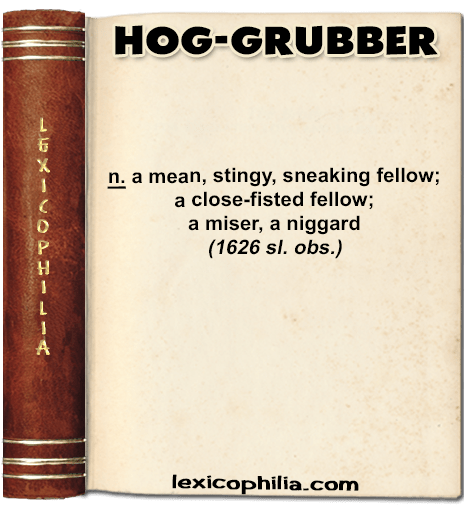
Word of the Day: HOG-GRUBBER


ETYMOLOGY
from hog + grubber (a person who gets wealth by sordid or contemptible methods)


EXAMPLE
“…The next that in our little Ease,
Came to be bit with Lice and Fleas,
Was a spruce Knave, like none of these, But sober,

As the Strand May-pole, – he did go,
In russe, – His thumb th’row ring, did show
A Gentleman seal’d, – for he was no Hog-grubber:

It was a Petty-fogging Varlet,
Whose back worse freez, but burn no scarlet,
And was tane napping with his Harlot, At noddy: …”

From: The Counter-Scuffle
Whereunto is added, the Counter-Ratt
By Robert Speed, 1626

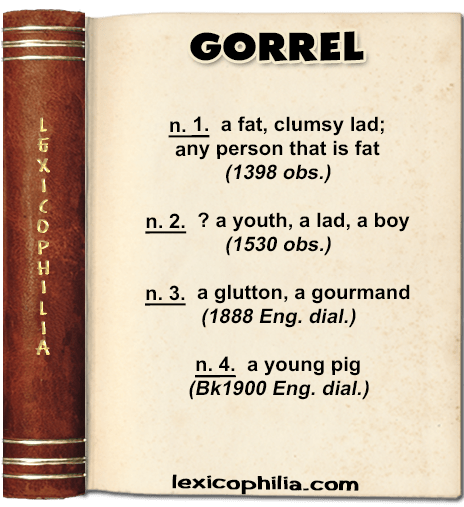
Word of the Day: GORREL


ETYMOLOGY
from Old French gorelgorreau (a pig, hog);
related to Old French gore (sow): of unknown origin.


EXAMPLE (for n. 1.)
“…Crampe that comyth of replycyon fallyth ofte to fatte men and flesshly and well fedde and gorrelles…”

From: Bartholomew de Glanville’s De Proprietatibus Rerum,
Translated by John Trevisa, 1495

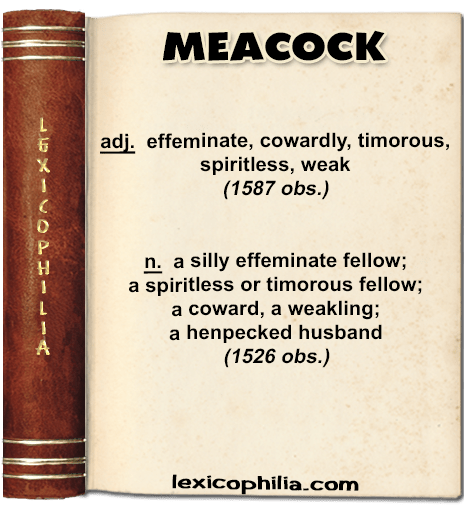
Word of the Day: MEACOCK


ETYMOLOGY
of obscure origin: perhaps originally a name of some bird  
(From Murray’s N.E.D.: “the suggestion that it is from meek (adj.) is untenable”)


EXAMPLE
“…He shuld be no cowarde, no maycocke, ne fearfull persone that dare no thyng enterprise….”

From: Here Begynneth a Deuout Treatyse in Englysshe, called the Pylgrimage of Perfection,
By William Bonde, 1526

Word of the Day: PEDISSEQUOUS


ETYMOLOGY
from Latin pedisequus (following on foot, a foot-follower), 
from pedi- (foot) + -sequus (following), sequī (to follow)


EXAMPLE
“…not onely melancholical and contumacious ones, but viscid and pituitous also, which sometimes put on the habit of Melancholly, and some adust bilious humours: and therefore we adde Rhabarb and Turbith, that we may with the Melancholical Captain-humour, educe the Pituitous, his companion inseparable, and also the Bilious, which is pedissequous.
And because this Medicament most respects melancholy, we have selected black Hellebore for this black humour; rejecting the white, as more convenient for Phlegm…”

From: A Medicinal Dispensatory: Containing the Whole Body of Physick
By Jean de Renou
Translated by Richard Tomlinson, 1657
The Apothecaries Shop: Of Liquid Electuaries

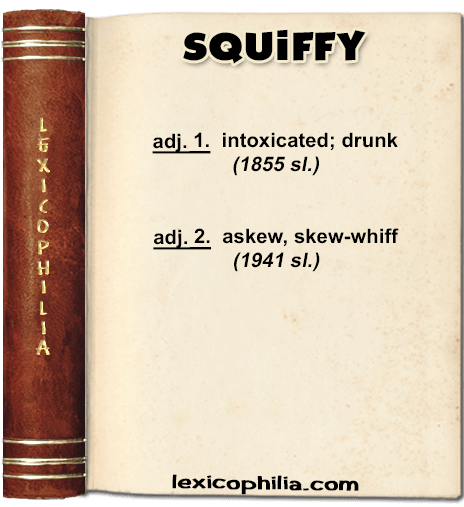
Word of the Day: SQUIFFY


ETYMOLOGY
of fanciful formation


EXAMPLE
“…Curious enough, there is a Lady Erskine, wife of Lord E, her husband’s eldest brother living at Bollington, who tipples & ‘gets squiffy‘ just like this Mrs E. …”

From: The Letters of Mrs. Gaskell
By Elizabeth Cleghorn Gaskell, 1855
Edited by J. A. V. Chapple, ‎Arthur Pollard, 1966

Word of the Day: FAUNTEKIN


ETYMOLOGY
diminutive of faunt: aphetic form of Old French enfauntenfant;
the shortened form has not been found in French, but Italian has the corresponding fante (boy, servant, foot-soldier), whence German fant


EXAMPLE
“…”Þat is soth,” quod clergye “I se what þow menest,
I shal dwelle as I do my deuore to shewen,
     And conformen fauntekynes and other folke ylered,
Tyl pacience haue preued þe and parfite þe maked…”

From: The Vision of William concerning Piers the Plowman,
By William Langland, 1377

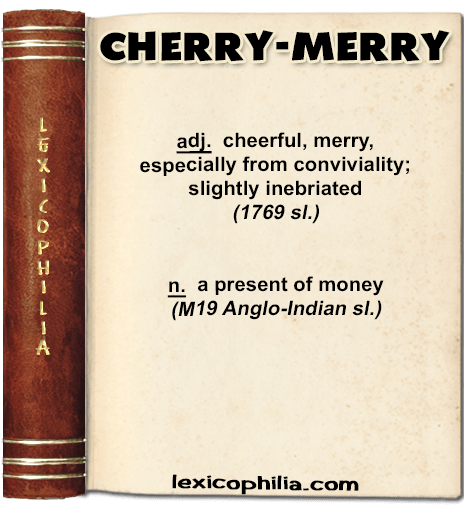
Word of the Day: CHERRY-MERRY


ETYMOLOGY
perhaps from cheery + merry; possibly only a jingling combination


EXAMPLE
“…how few of you are enemies to a glass (or two or three) of generous wine, and how much food of such a heating nature, promotes the circulation of the bottle, it is not at all astonishing, that every convivial assistant should go home cherry-merry, after having been a guest at such a repast…”

From: Yorick’s Sentimental Journey Continued,
By John Hall-Stevenson, 1769

Word of the Day: TARADIDDLE


ETYMOLOGY
the first element, tara, is of obscure origin;
+ diddle (n. a swindle, deception) (vb. to cheat, to swindle)


EXAMPLE
“…Bar. My dear Anna Matilda, I don’t know myself; so how can I tell you?
Mrs. B. There’s a bare-faced tarradiddle, Mr. Barbottle…”

From: The Duel:
Or, My Two Nephews 
A Farce, in Two Acts
By R. B. Peake, 1823