ETYMOLOGY
from high + stomached
EXAMPLE
“…For the which in those dayes, they had moche a do with these hygh stomaked Romanes…”
From: The Actes of Englysh Votaryes
By Iohan Bale, 1546
ETYMOLOGY
from high + stomached
EXAMPLE
“…For the which in those dayes, they had moche a do with these hygh stomaked Romanes…”
From: The Actes of Englysh Votaryes
By Iohan Bale, 1546
ETYMOLOGY
from penny + father
EXAMPLE
“…This skapethrifte, throweth his good{is} against the walles. That pennie father, skrapeth it togethers, bothe by God, and by the diuell…”
From: The Praise of Folie
Moriæ encomium a booke made in Latine by that great clerke Erasmus Roterodame,
Translated by Thomas Chaloner Knight, 1549

ETYMOLOGY
from Latin derogatorius derogatory + -ous
EXAMPLE
“…if the said archbishop intermeddled after the said provocation, his doings were derogatorious not only to the dignity of the patriarche but to the supremacy of the Pope and to the authority also of the general Counsell…”
From: A Treatise on The Pretended Divorce Between Henry VIII and Catharine of Aragon
By Nicholas Harpsfield, a1575
Modernized Text By Nicholas Pocock, 1878

ETYMOLOGY
from Latin insipientem, from in- + sapientem (wise, sapient)
EXAMPLE
“…Where the Chylde or Insypient drynkyth the swete and delycious wordis unauysydly…”
From: The New Cronycles of Englande & Fraunce
By Robert Fabyan, a1513
ETYMOLOGY
of uncertain origin
EXAMPLE
“…The Emperour yaf the Pope somtyme
So hyghe lordshyp hym aboute,
That at the laste the sely kyme
The proude Pope putte hym out!
So of thys realme is in doute,
But lordes be ware and them defende;
For nowe these folke be wonder stoute:
The kynge and lordes nowe thys amende!…”
From: The Ploughman’s Tale, c1535
ETYMOLOGY
after the manner of Cleopatra
EXAMPLE
“…Oh, Cleopatricall! what wanteth there
For curious cost, and wondrous choise of cheare?
Beefe, that earst Hercules held for finest fare;
Porke for the fat Boeotian; or the hare,
For Martiall, fish, for the Venetian…”
From: Virgidemiarum
By Bishop J. Hall, 1597
Satire III
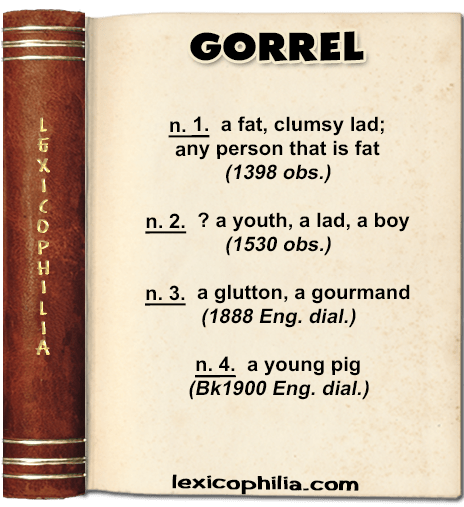
ETYMOLOGY
from Old French gorel, gorreau (a pig, hog);
related to Old French gore (sow): of unknown origin.
EXAMPLE (for n. 1.)
“…Crampe that comyth of replycyon fallyth ofte to fatte men and flesshly and well fedde and gorrelles…”
From: Bartholomew de Glanville’s De Proprietatibus Rerum,
Translated by John Trevisa, 1495
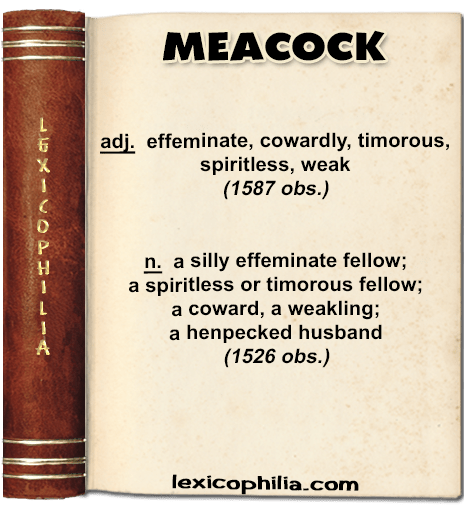
ETYMOLOGY
of obscure origin: perhaps originally a name of some bird
(From Murray’s N.E.D.: “the suggestion that it is from meek (adj.) is untenable”)
EXAMPLE
“…He shuld be no cowarde, no maycocke, ne fearfull persone that dare no thyng enterprise….”
From: Here Begynneth a Deuout Treatyse in Englysshe, called the Pylgrimage of Perfection,
By William Bonde, 1526

ETYMOLOGY
from Latin morigeratus, past participial stem of morigerari (to to be obedient or compliant), from morigerus
EXAMPLE
“…Certaynely in the auncient tyme, whan thou were peopled with ryght and trewe Romayns, and not as thou arte nowe with bastarde chylderne, than the armies, that wente froo Rome, were as well disciplyned and morigerate, as the schooles of the philosophies, that were in Grece…”
From: The Golden Boke of Marcus Aurelius,
By Antonio de Guevara, 1546
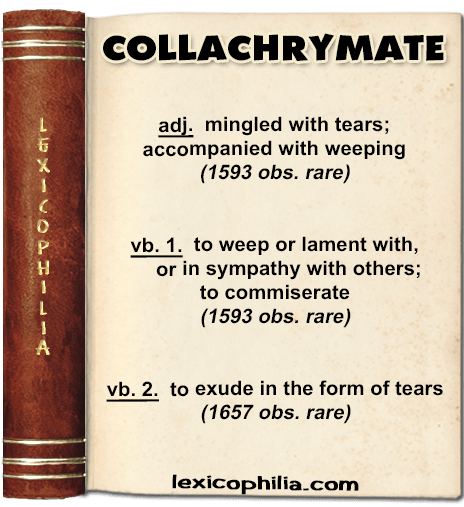
ETYMOLOGY
adj.: from Latin collacrimatus, pa. pple. of collacrimare;
vb. : from Latin collacrimat- ppl. stem of collacrimare, from col- (together) + lacrimāre (to shed tears, weep), from lacrima (tear)
EXAMPLE
“…A tormentor would collachrymate my case, and rather choose to have been tortured himself than torment me with ingratitude as thou dost…”
From: Christs teares ouer Ierusalem,
By Thomas Nashe, 1593
 Lexicophilia