Word of the Day: NIGHT-WORM

ETYMOLOGY
from night + worm

EXAMPLE (for n. 1.)
“… Ye noble Pryncis, conceyueth the sentence
Off this story, remembrid in scripture,
How that Sampson off wilful necligence
Was shaue & shorn, diffacid his figure;
Keep your conceitis vnder couerture,
Suffre no 
nyhtwerm  withynne your counsail kreepe,
Thouh Dalida compleyne, crie and weepe!
…”

From: The Fall of Princes
Translated by John Lydgate, a1439
Edited by Dr. Henry Bergen
The Early English Text Society, 1924
Word of the Day: MORIGEROUS

ETYMOLOGY
from Latin morigerus (compliant, obliging), (from mor-mos [custom, humour] + gerere [to bear, carry]; after the phrase morem gerere [to humour or comply with the wishes of a person]) + -ous

EXAMPLE
“… Call. What pleases Timon, cannot mee displease.

Phil. Timon, thou hast a wife morigerous
Shee is the onely comfort of my age.
…”

From: The Life of Timon of Athens
Generally attributed to William Shakespeare and Thomas Middleton, c1600

Word of the Day: ENGLIFY

ETYMOLOGY
from Engl- (in English) + ‑ify 

EXAMPLE
“… This is the true shape of it, concerning which I have formerly written, chap. 10. numb. 15, 16. This is by some termed a Frog seiant, A. a Fesse between three of them Vert, is the coat of Paddock, a breviation from Ap Addock, a Welsh name Englified, as is very usual with them when they come to inhabit amongst the English, as Iohn ap Richard to be called Iohn Pritchard, William ap Hugh, to be called William Pugh, and the like. …”

From: The Academy of Armory, or, A storehouse of armory and blazon containing the several variety of created beings, and how born in coats of arms, both foreign and domestick: with the instruments used in all trades and sciences, together with their their terms of art
By Randle Holme, 1688

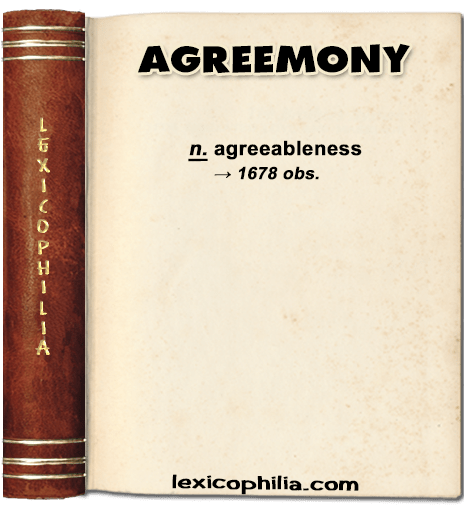
Word of the Day: AGREEMONY

ETYMOLOGY
alteration of acrimony, punningly after agreement

EXAMPLE
“... Upon my Reputation, Madam, you’re a civil well-bred Person, you have all the Agreemony of your Sex, La Bell Talie, la Boon Mien, & reparteét bien, and are tout one toore, as I’me a Gentleman, fort agreeable. — If this do not please your Lady, and Nauseate her, the Devil’s in ’em both for unreasonable Women. …”

From: Sir Patient Fancy: a comedy
By Aphra Behn, 1678

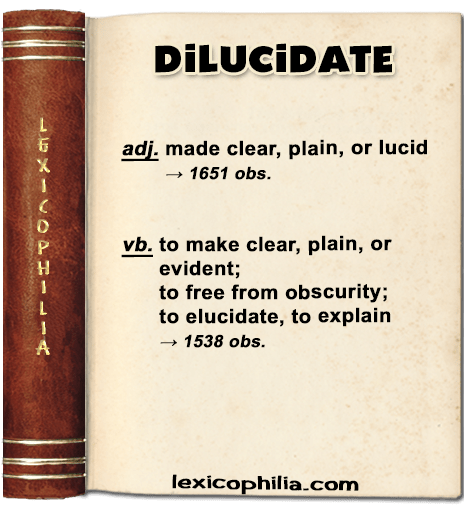
Word of the Day: DILUCIDATE

ETYMOLOGY
adj.:  from Latin dilucidatus, past participle of dilucidare (to make clear, to explain), from dilūcidus (clear, bright)
vb:  from Latin dilucidat- participial stem of dilucidare (to make clear, to explain)

EXAMPLE (for vb.)
“… .For we folowe not only a standynge text of the Hebrue, with the interpretacion of the Caldee, and the Greke, but we set, also, in a pryvate table, the dyversite of redinges of all textes, with suche annotacions, in another table, as shall douteles delucidate and cleare the same; as well without any singularyte of opinions, as all checkinges and reprofes. The prynt, no doubt, shall please your good Lordship. …”

From: State papers, published under the authority of His Majesty’s Commission. King Henry the Eighth
Coverdale and Grafton to Crumwell, 1538

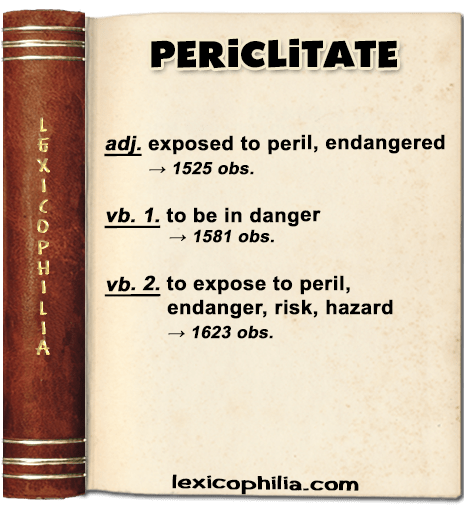
Word of the Day: PERICLITATE

ETYMOLOGY
adj.:  from Latin periclitatus (tried, tested, endangered) past participle of periclitari
vb:  from Latin periclitat-, past participial stem of periclitari (to expose to risk, danger, or peril), from periculumpericlum (trial, risk, danger)

EXAMPLE (for adj.
“… He alone be not noted to be the occasion of longer division werre and hostilite in Cristendome, wherby the hole state of the same may be periclitate and put in extreme daunger, but that by deliverance of the Frenche King, upon a convenient rawnsom, ther may ensue, God willing, generall peax bitwene al Cristen Princes, wherin He shal, besides the thanke of God, adquire more honour, than though by extreme force and violence He had attayned suche an other realme as Fraunce is. …”

From: State papers, published under the authority of His Majesty’s Commission. King Henry the Eighth, 1830
King Henry VIII. to Tunstall, &c., 1525

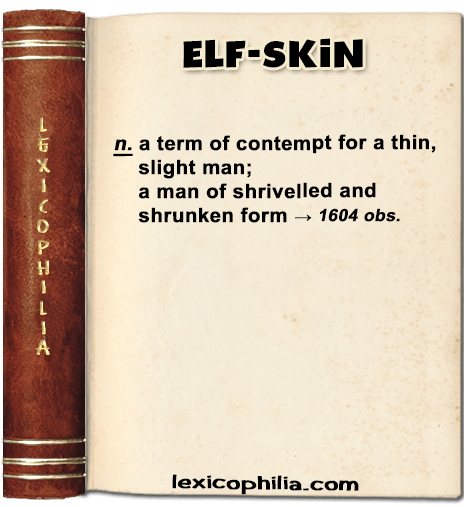
Word of the Day: ELF-SKIN

ETYMOLOGY
some editors suggest “elf-skin” is a misprint for “eel-skin

EXAMPLE
“… Zbloud you starueling, you elfskin, you dried neatstongue, you buls-pizzel, you stockefish: O for breath to vtter what is like thee, you tailers yard, you sheath, you bowcase, you vile standing tuck. …”

From: William Shakespeare, The Complete Works
Edited by Stanley Wells and Gary Taylor, 1986
The history of Henrie the Fourth. 1604

Word of the Day: SOLIVAGOUS

ETYMOLOGY
from Latin solivagus, from solus + vagari (to wander)

EXAMPLE
“… Other creatures live free and independent upon one another, except the young ones of some Creatures, while they can seek their Food and Preservation; and are either Solivagous and Hurtful, as Foxes, Wolves and Tigers, &c. or live promiscuously in Herds and Flocks, and are innocent Creatures as Sheep, Goats, &c. whereas Men live in Dependency one upon another, so as no Man can subsist of himself; …”

From: A Detection Of The Court and State Of England During The Four Last Reigns 
and the Inter-Regnum.
By Roger Coke, 1697
The Reign of King Charles II. A. D. 1661

Word of the Day: LADYKIN

ETYMOLOGY
from lady + -kin

EXAMPLE
“… .In the time of Ieremie the land mourned for oathes, in our time it is to be wondred, that the land sinkes not to hell under the burden of this sinne: there is hardly one of an hundred that makes conscience of all oathes: they haue pettie oathes (as they account them) and coyne strange Gods to sweare by, the Masse, Ladikin, or Lakin, and much like grosse profanenesse they continually use without feare or wit: yet is cursing as ordinary as swearing, and drunkrnnesse comes not behind any of them, how generall it is, and how it hath, and doth infect, witnesse the ruine of many families, the pining and leane cheekes of many wiues and children, and the loathsome stinke of it in every corner. ..”

From: The Way to Blessednes a Treatise or Commentary, on the First Psalme
By Phineas Fletcher, 1632

Word of the Day: CREDULIST

ETYMOLOGY
from Latin credulus (ready to believe or trust) + -ist

EXAMPLE
“… the couetous Bashaw of Aleppo, the gouernor of those parts, are contented to beare with things euen contrary to the lawes of their Alcheron, impugning altogether the Godhead and incarnation of Christ: as the Iews against his pouerty and humiliation: & for great sums of mony, & annuall entrado, suffer stil diuers friers & religious persons to entertain pil∣grims, trauellers, ignorant deuotists, superstitious papists, and simple credulists, with impudent, lying, & deceitfull relicks …”

From: The Secretaries Studie Containing New Familiar Epistles
By Thomas Gainsford, 1616