Word of the Day

Word of the Day: HALF-HEADED


ETYMOLOGY
from half + headed


EXAMPLE
“…And there is not a man that is for Paritie, all Fellows in the Church, but he is not for Monarchie in the State. And certainly either he is but Halfe-headed to his owne Principles, or he can be but Halfe-hearted to the House of David…”

From: Seven Sermons Preached Upon Severall Occasions
By William Laud, 1625

Word of the Day: UBIQUARIAN


ETYMOLOGY
from Latin ubique (wherever, anywhere, everywhere) + -arian


PRONUNCIATION
yoo-buh-KWAIR-ee-uhn


EXAMPLE (for adj. 1)
“…Tho’ detestable the place,
Mean the lodgings, small and base,
Tho’ the crowded hoy pours forth
Company of little worth,
Coach or chariot, tho’ there’s none,
Rattling thro’ the fishing town,
Yet, Maria, yet, my fair,
Happiness shalt find us here:
Happiness our friend shall be,
Ubiquerian deity!
…”

From: The Gentleman’s Magazine and Historical Chronicle
Volume XXXII, 1762
Happiness Every Where
Occasioned by a fair Lady’s condemning the Author’s choice of Margate, for a Place of Entertainment

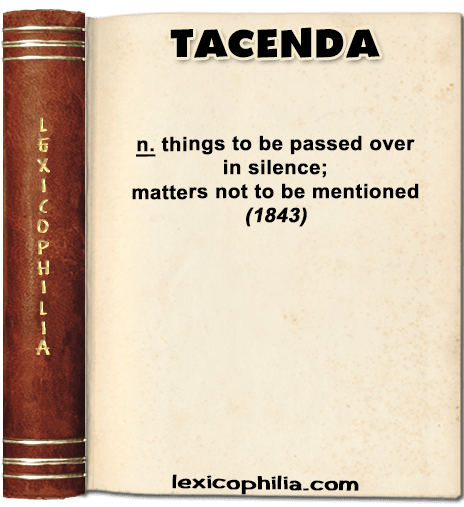
Word of the Day: TACENDA


ETYMOLOGY
Latin, gerundive neuter pl. of tacere (to be silent)


EXAMPLE
“…With due rigour, Willelmus Sacrista, and his bibations and tacenda are, at the earliest opportunity, softly, yet irrevocably put an end to. The bibations, namely, had to end; even the building where they used to be carried on was razed from the soil of St. Edmundsbury, and ‘on its place grow rows of beans:’ Willelmus himself, deposed from the Sacristry and all offices, retires into obscurity, into absolute taciturnity unbroken thenceforth to this hour…”

From: Past and Present
By Thomas Carlyle, 1843

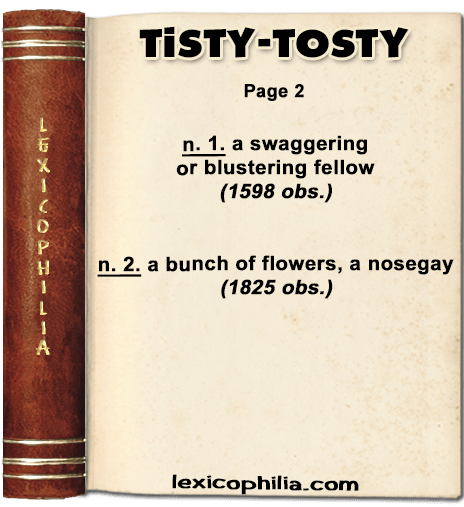
Word of the Day: TISTY-TOSTY


ETYMOLOGY
for int.: perhaps a mere ejaculation
for n. 2.: it has been compared with obsolete tyte tust(e) or obsolete tussemose (a nosegay)


EXAMPLE
“…And now I wil daunce, now wil I praunce,
For why I haue none other woork:
Snip snap Butter is no bone meat:
Knaues flesh is no Porke.
Hey tisty tosty an Ole is a bird,
Iack a napes hath an olde face:
You may beleeue me at one bare woord,
how like you this mery cace?
…”

From: A Pleasant Enterlude, Intituled, Like Will to Like Quoth the Deuill to the Collier
By Ulpian Fulwell, 1568

Word of the Day: DEMULCEATE


ETYMOLOGY
irreg. formed on Latin demulcere (to stroke down, to soothe caressingly) + -ate


EXAMPLE
“…Gallantry, sir, (said he, turning to me) or the exalted science of demulceating the amiable reservedness, and overcoming the attractive pudicity, of the gentler sex, by the display of rare and excellent endowments, was a discipline worthy of the accomplished chevaliers of these most memorable eras …”

From: Blackwood’s Edinburgh Magazine
Volume I, April – September, 1817
Fragment of a Literary Romance

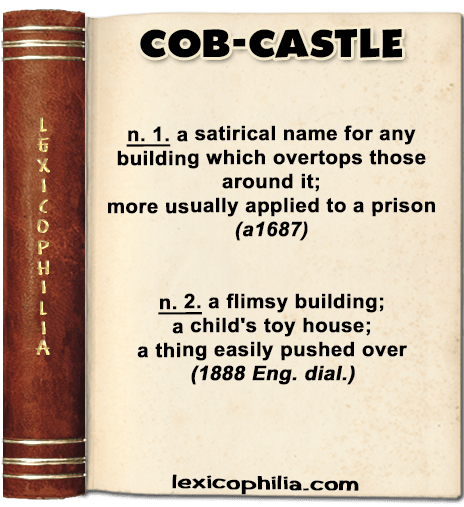
Word of the Day: COB-CASTLE


ETYMOLOGY
? from cob (a big man, a great man, a leading man) + castle


EXAMPLE
“…’Twixt the wood and the castle they see at high water
The storm, the place makes it a dangerous matter;
And besides, upon such a steep rock it is founded,
As would break a man’s neck, should he’scape being drowned:
Perhaps though in time one may make them to yield,
But ’tis prettiest Cob-castle e’er I beheld
…”

From: Poems on Several Occasions written by Charles Cotton, 1689
A Voyage to Ireland in Burlesque

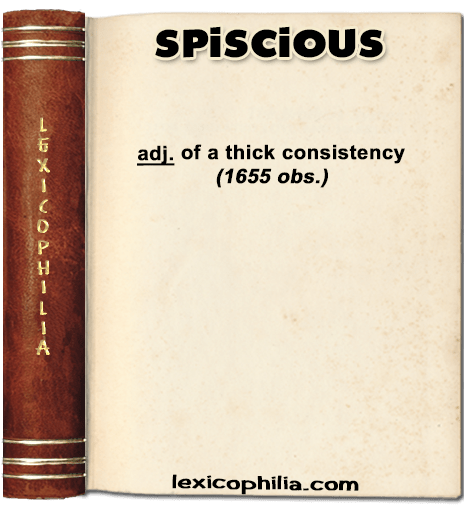
Word of the Day: SPISCIOUS


ETYMOLOGY
from Latin spissus (thick, close, compact)


EXAMPLE
“…Methought this Drink had a kind of a sweet taste, like Asses Milk, yet it could not properly be called a liquor, but rather a certain concreted Mist or spiscious Froath; for being with no small paine got out againe, I found it had not so much as moistned my Cloaths…”

From: The Comical History of Francion
By Charles Sorel, 1655

Word of the Day: LITTLE-WHAT


ETYMOLOGY
from little + what


EXAMPLE
“…Philip answeride to him, The looues of two hundrid pens suffysen not to hem, that ech man take a litle what…”

From: The Holy Bible, containing the Old and New Testaments, with the Apocryphal books, in the earliest English versions made from the Latin Vulgate
(Wycliffite, early version), c1384

Word of the Day: SNUFFY


ETYMOLOGY
from snuff + -y


EXAMPLE
“…I’m sure she makes a very Tarquinius Sextus of me, and all about this Serenade,—I protest and vow, incomparable Lady, I had begun the sweetest Speech to her—though I say’t, such Flowers of Rhetorick—’twou’d have been the very Nosegay of Eloquence, so it wou’d; and like an ungrateful illiterate Woman as she is, she left me in the very middle on’t, so snuffy I’ll warrant…”

From: Sir Patient Fancy
By Aphra Behn, 1678