Word of the Day

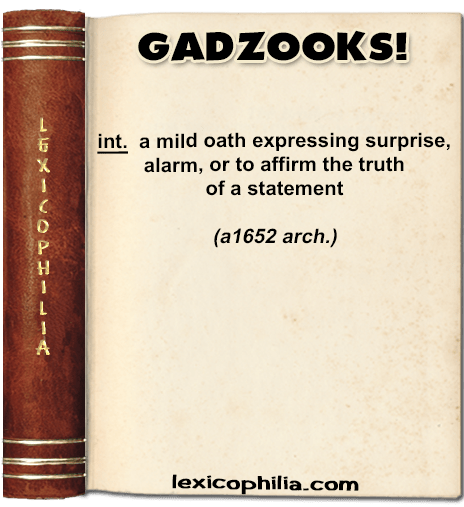
Word of the Day: GADZOOKS!


ETYMOLOGY
from gad (used to express strong feeling) + zooks (origin unknown)


EXAMPLE
“…Buz. Ile first take tother cup, and then out with’t altogether—And now it comes—If my Mistress do bring him home a bastard, she’s but even with him.

Nat. He has one I warrant. Has he cadzooks?…”

From: The English Moor or the Mock-Marriage,
in Five Nevv Playes, viz. The English Moor. The Love-sick Court. Covent Garden Eeeded. The New Academy. The Queen and Concubine,
By Richard Brome, 1659
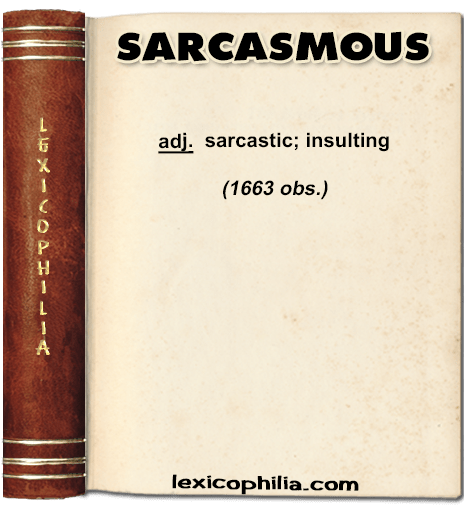
Word of the Day: SARCASMOUS


ETYMOLOGY
from sarcasm + -ous


EXAMPLE
“…Like th’ Hebrew-calf, and down before it
The Saints fell prostrate, to adore it.
So say the Wicked—and will you
Make that Sarcasmous Scandal true.
By running after Dogs and Bears,
Beasts more unclean than Calves or Steers?…”

From: Hudibras: in three parts, the first part
By Samuel Butler, 1663

Word of the Day: VERILOQUOUS


ETYMOLOGY
from Latin veriloquus (speaking truly)


EXAMPLE
“…Those ungrateful disingenuous Galenists (who always resisting the truth, set this Brazenface on work deceitfully to oppose Haematias.) contrived heretofore a scurrilous Pamphlet against a veriloquous treatise of mine, (namely A Chymical tryal of the Galenists) and injoyned Johnson their Pseudo-Chymist to patronize it…”

From: A Letter Sent to Mr. H. Stubbe,
By George Thomson, 1672
‘Animadversions on Mr. Stubbe’s Answer’

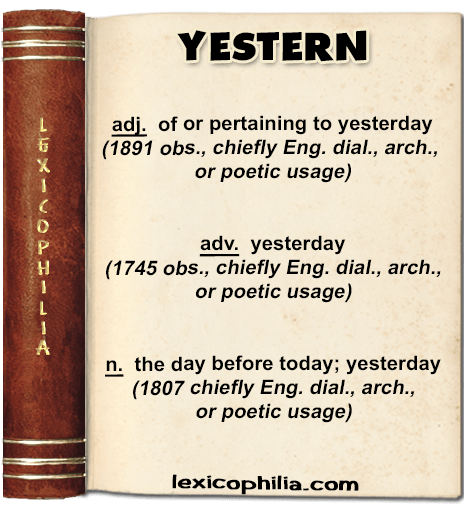
Word of the Day: YESTERN


ETYMOLOGY
? partly a) (in English editions of Scots texts) a variant or alteration of yestreen (adv. during the evening of yesterday), after yester (adv. yesterday); and partly
b) a variant or alteration of yester (adv.), yester (n.), and yester (adj.), respectively


EXAMPLE
“…Now wat ye wha I met yestern,
Coming down the street, my jo?
My mistress in her tartan screen,
For bony, braw and sweet, my Jo…”

From: Allan Ramsay in Aviary, 1745
‘Edinburgh Kate’

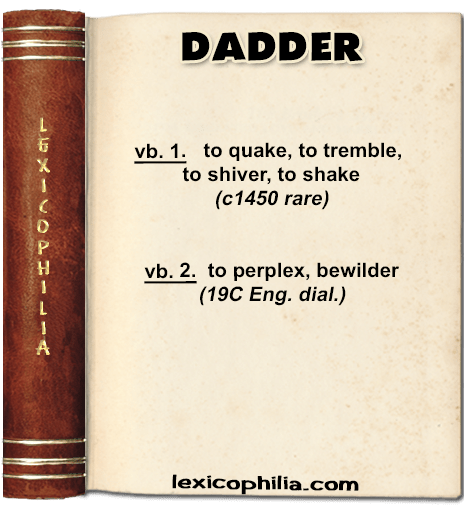
Word of the Day: DADDER


ETYMOLOGY
possibly imitative (perhaps of the chattering of teeth)


EXAMPLE
“…Full gayly was that grete lorde . girde in the myddis,
A brighte belte of ble, . broudirde with fewles,
With drakes and with dukkes, . daderande tham semede,
For ferdnes of fawcons fete, . less fawked thay were…”

From: Winnere and Wastoure 
(“Winner and Waster” is a Middle English poem written in alliterative verse around the middle of the 14th century)

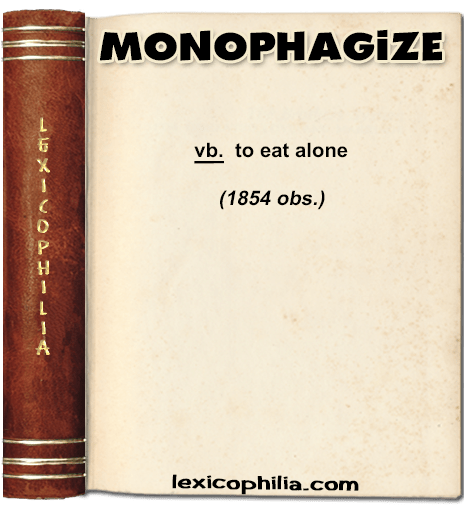
Word of the Day: MONOPHAGIZE


ETYMOLOGY
from Greek µονοϕάγος (monofagos) (that eats alone) + -ize


EXAMPLE
“…you who make us fight for every cabbage at the greengrocer’s, and prestige in its favour, that whereas the glutton might sometimes munch and monophagize in solitude, leading the life of a wolf or of a lion, those who drank generally drank together, and, as it was always said and supposed, to each other’s health and prosperity…”

From: Prose Halieutics
Or, Ancient and Modern Fish Tattle
By the Rev. C. David Badham, 1854
Chapter XXII. Opsophagy

Word of the Day: CHATTERMAG


ETYMOLOGY
from chatter + mag (a chatterbox)


EXAMPLE
“…Now then, stop that; we don’t want no such dal’d nonsense; we come here to work. Now then, you women, divide into twos, and begin at both ends, or we shan’t get any work done for your chattermagging…”

From: Stubble Farm;
Or, Three Generations of English Farmers
By Hubert A. Simmons, Vol. II, 1880
Chapter I. P. 14

Word of the Day: MORIGERATE


ETYMOLOGY
from Latin morigeratus, past participial stem of morigerari (to to be obedient or compliant), from morigerus


EXAMPLE
“…Certaynely in the auncient tyme, whan thou were peopled with ryght and trewe Romayns, and not as thou arte nowe with bastarde chylderne, than the armies, that wente froo Rome, were as well disciplyned and morigerate, as the schooles of the philosophies, that were in Grece…”

From: The Golden Boke of Marcus Aurelius,
By Antonio de Guevara, 1546